


Concept Sketches
We'll start with concept sketches to explore the overall direction of your piece. These are loose, expressive drawings that bring your story to life, so don't hold back. Go as bold or as minimal as you'd like. From there, we'll collaborate and refine the ideas together until everything feels just right.
2
With the concept locked in, we move into 3D modeling where the vision becomes dimensional. Every element is carefully refined, with form, and proportion, to develop the piece into something tangible and precise.

3D Model

Render
3
A detailed 3D rendering is developed to study and refine the surface finish, or patina - an essential element that defines the sculpture's final presence. In bronze, patinas are created through the controlled application of heat and chemical treatments, yielding rich, nuanced effects. As certain finishes demand different levels of care and longevity, we collaborate with you at this stage to select a patina direction that aligns seamlessly with both your aesthetic vision and long term expectations.
4
The Mother (sometimes called the master) represents the finalized sculpture, the exact reference from which the bronze casting will be produced from. In the case of larger works, the form may be segmented to optimize the casting process, with each component later reassembled to achieve a seamless result
This stage marks a point of commitment- once the Mother is created, the design is locked in. No further changes can be made beyond this point.
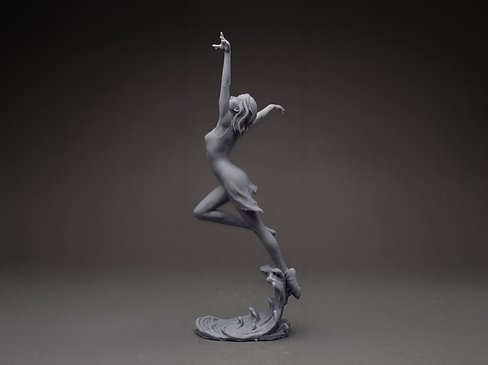
The Mother

Mold Making
5
Using the Mother as the foundation, a flexible rubber mold is carefully created to capture every detail of the sculpture. This mold is then reinforced with a durable outer shell-typically made of plaster or fiberglass-providing the strength and stability needed for the casting process.
6
Molten wax is carefully poured into the mold, forming a consistent shell approximately 3/16 inch (4.75mm) thick. As the wax cools and solidifies, it captures every detail of the original design. Once removed from the mold, it reveals a precise, highly detailed wax replica of the Mother.

Wax Pouring

Spruing
7
Once the wax chasing is complete, a system of sprues (wax channels) and a pouring cup are strategically added to the pattern. These elements create a pathway for the molten metal, ensuring it flows evenly and solidifies properly-setting the stage for a flawless casting.
8
Layer by layer, up to a dozen coats of ceramic are carefully applied to the wax form, building a strong outer shell. The sprues are fully encased and reinforced as this shell develops. Once fired, the wax melts away, leaving behind a hollow, highly precise hollow cavity that will be filled with molten metal
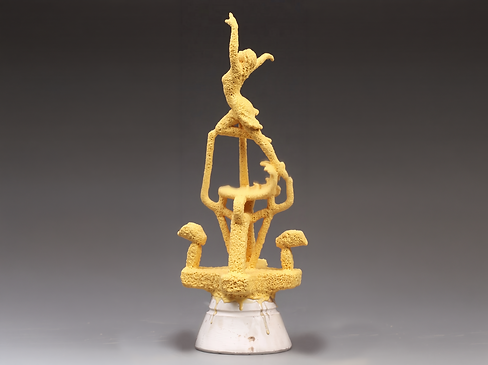
Shell
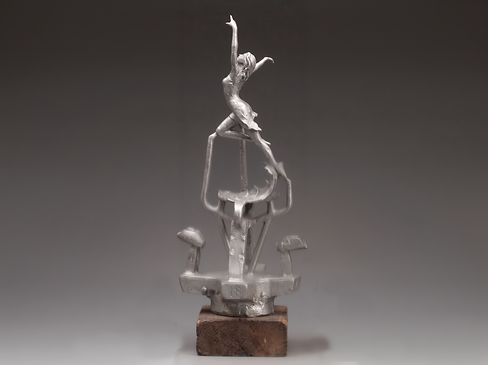
Metal Pouring
9
After the wax is melted out, molten bronze is poured into the shell and allowed to cool and take shape. The ceramic shell is then broken away, unveiling the newly formed casting. At this stage, the piece will appear rough and unrefined, but marks the beginning of the of the finishing process to bring the piece to life.
10
From here, the sprues are carefully removed and the surface is cleaned and refined. If the sculpture was cast in multiple sections, those parts are expertly welded together and blended seamlessly, bringing the full form together as one cohesive work.
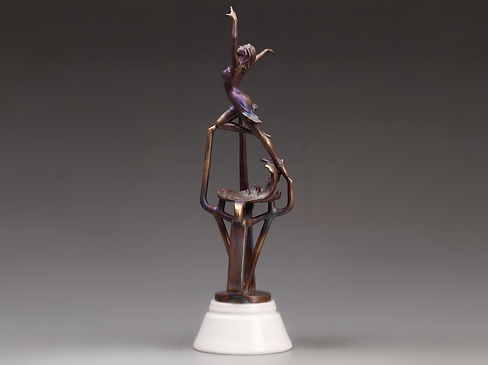
Assembly

Metal Chasing
11
Metal chasing is the finishing stage where the surface is carefully reworked to eliminate weld marks and refine any irregular textures. Every detail is reworked by hand to restore clarity and precision, ensuring the piece faithfully reflects the original design intent in it's final form.
12
A series of specialized finishes and chemical treatments are applied to the bronze to achieve the precise color and surface character envisioned in the original rendering. The completed sculpture is mounted on the appropriate based and carefully packed, ensuring it is protected and ready for it's final journey.
